
Partial Knee Replacement
Dr. Popa uses a muscle-sparing subvastus approach for medial partial knee replacements. He also incorporates computer navigation for each knee replacement to ensure the accuracy of the position and size of the implants for each patient’s individual knee. Dr. Popa utilizes either the Smith and Nephew CORI navigation system or the Stryker Mako robotic system depending on the facility where the surgery is performed.
The Procedure
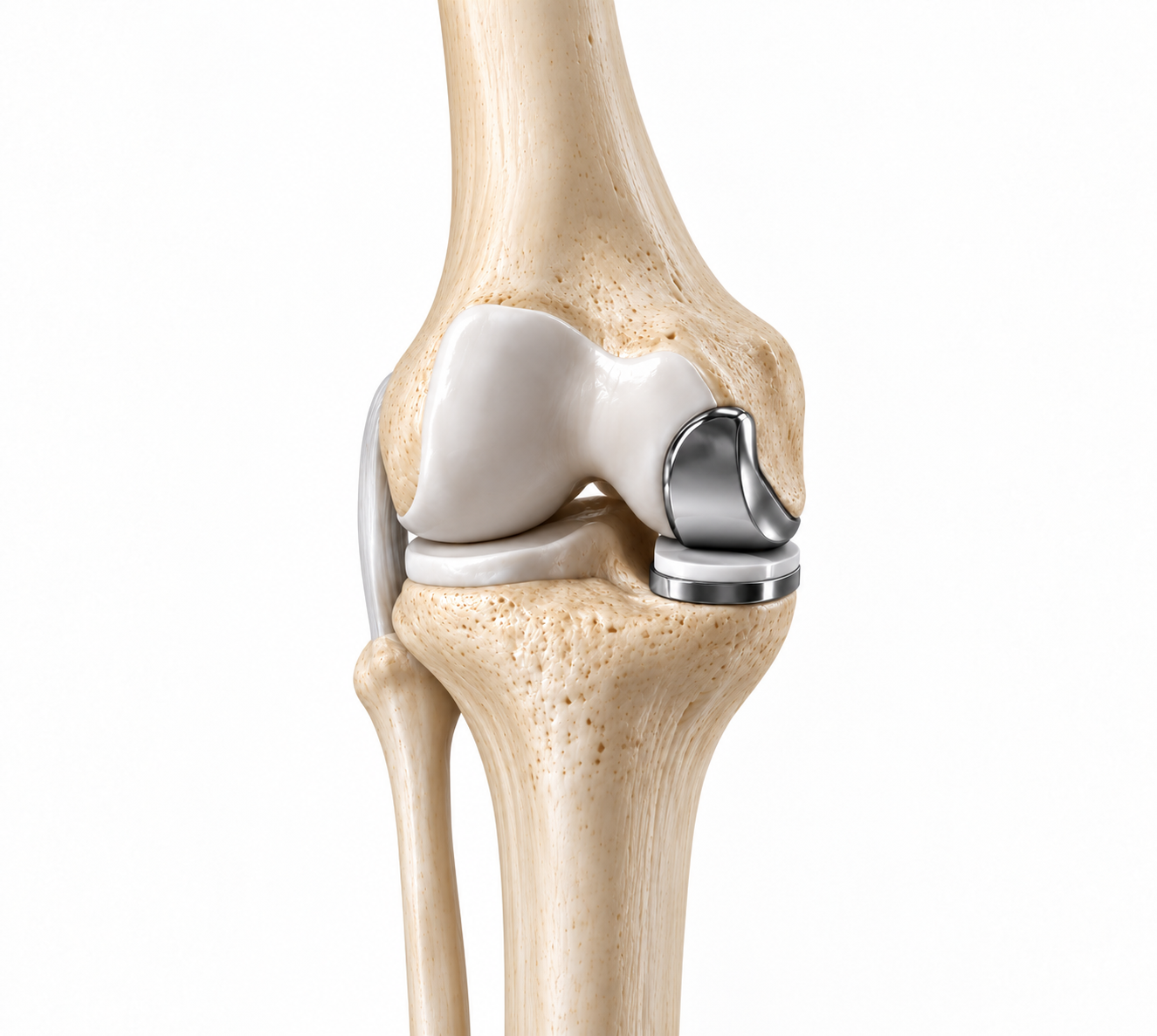
An orthopaedic surgeon thinks of the knee as having three parts - the medial compartment (inside part), the lateral compartment (outside part), and the patellofemoral compartment (kneecap part). Occasionally, arthritis may only affect one part of the knee joint, most commonly the inside part of the knee. In those situations, a partial knee replacement may be the best surgery for a patient.
During a partial knee replacement, an incision is made over the front of the knee to reveal the parts that are worn out from the arthritis. The arthritic parts are removed using specialized instruments. Computer navigation is used for guidance to ensure accuracy for positioning and sizing of the implants for each patient’s individual knee.
Once the correct implants are determined, the metallic parts of the prosthesis are secured to the bone with bone cement to hold them in place. A plastic liner is snapped into place between the thigh bone and shin bone components so the knee will glide smoothly.
If the kneecap compartment is being replaced, a metallic cap will be secured onto the front of the thigh bone using bone cement. A plastic button will then replace the kneecap.
Should I think about partial knee replacement?
You might benefit from partial knee replacement if:
One of the three compartments of your knee has been damaged by arthritis or a past injury and the other two compartments are in good shape.
You have bad knee pain that gets in the way of daily life.
Rest, medications, braces, exercises and physical therapy, and injections have not helped your knee pain sufficiently.
You want to recover mobility and improve your quality of life.